I've spent eight years fielding drinkware inquiries from wholesale buyers and e-commerce sellers across Europe and North America. Nine times out of ten, the conversation starts the same way: "We're looking at OEM and ODM options—which is better for us?" Here's the problem: that question assumes OEM versus ODM is a quality tier or a price bracket. It's not. The real choice comes down to where you are in your business cycle, how much product you need to move, and whether you have design files ready to send. Most buyers waste weeks comparing quotes on the wrong model because they never mapped their actual constraints first.
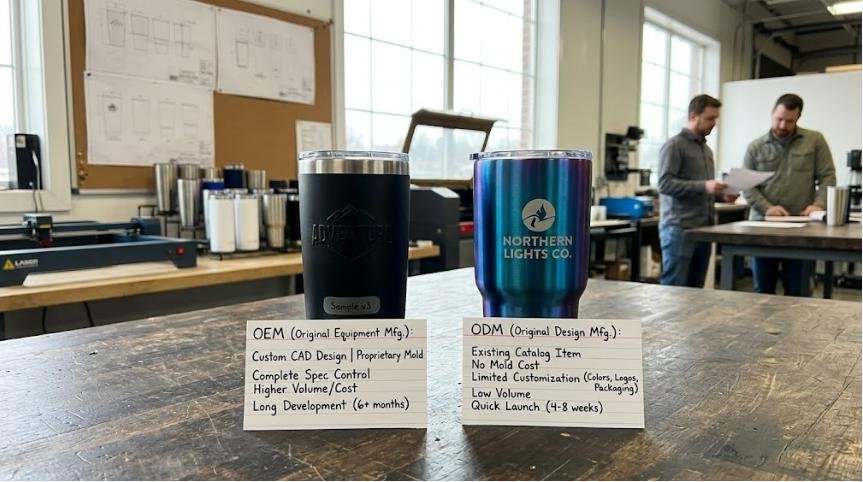
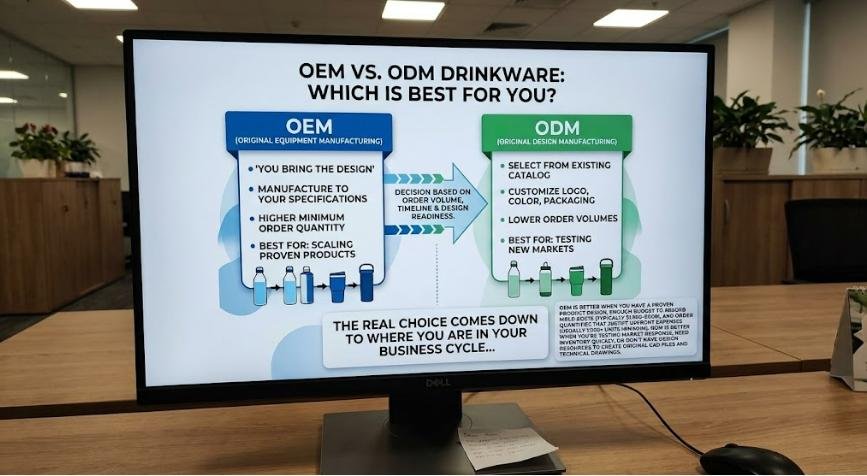
OEM (Original Equipment Manufacturing) means you bring the design and we manufacture to your specifications. ODM (Original Design Manufacturing) means you select from our existing product catalog and customize within predefined limits—logo placement, color swaps, packaging variations. The decision isn't about which is "better"; it's about which matches your current order volume, timeline pressure, and design readiness. If you're testing a new market with a $5,000 budget and no CAD files, ODM removes the mold cost barrier. If you're scaling a proven product and need differentiation from competitors reselling the same catalog items, OEM protects your design investment.
You're reading this because you're past the "what does OEM mean" stage. You need to know which model fits your actual constraints—your first order quantity, your available budget, your timeline until you need inventory in hand. The sections below break down the real variables buyers overlook when they ask me for quotes. By the end, you'll have a decision framework based on numbers, not assumptions.
Is OEM Better Than ODM?
I had a client last month with a beautifully rendered 3D design for a gradient-finish stainless steel bottle. They were ready to commit to OEM production—until I walked them through the timeline. New mold fabrication: three weeks. First sampling round: two weeks. Revision cycle if they wanted changes: another week. They needed product on shelves in eight weeks for a summer promotion. OEM wasn't "worse"; it was incompatible with their launch window.
OEM is better when you have a proven product design, enough budget to absorb mold costs (typically $1,500–$8,000 depending on complexity), and order quantities that justify those upfront expenses—usually 1,000+ units minimum. ODM is better when you're testing market response, need inventory quickly, or don't have design resources to create original CAD files and technical drawings.
When OEM Makes Strategic Sense
OEM ownership gives you control over every dimension: bottle shape, lid mechanism, handle ergonomics, finish textures. You're not competing with twenty other resellers offering the same ODM catalog item with different logos. If your brand positioning depends on a unique product form—say, a collapsible silicone bottle that fits specific bike cages—OEM is your only path.
The cost structure requires upfront capital. Beyond mold fees, you're funding sampling iterations before production begins. I typically see three scenarios where buyers justify this investment:
- Reorder businesses: You've validated demand through ODM or competitor analysis, and you're placing your third or fourth order. Mold costs amortize across future reorders.
- Brand differentiation plays: You're entering a crowded niche (like insulated tumblers) where shelf presence depends on standing out from identical catalog products.
- Proprietary feature requirements: Your bottle needs a custom spout for a specific user behavior (one-handed opening for cyclists, wide mouth for protein shakes with ice) that doesn't exist in standard ODM catalogs.
The MOQ floor sits around 1,000 units for most custom drinkware, though simple shape variations might start at 500. Complex multi-component designs (bottles with infuser chambers, dual-wall construction with copper lining) push minimums to 2,000–3,000 units because mold costs and setup time increase.
When ODM Provides Faster Market Entry
ODM removes the design phase entirely. You're selecting from proven molds we've already fabricated for other clients or our own product line. Customization happens within fixed parameters: logo screen printing or laser engraving, PMS color matching for bottle bodies (if the product line supports it), custom packaging inserts or hang tags.
The three client types who benefit most from ODM in my experience:
- E-commerce testers: You're launching a Shopify store or testing a new product category on Amazon. You need 300–500 units to validate demand before committing to custom tooling. ODM's lower MOQs (often 500 units, sometimes 300 for stock items) fit your test budget.
- Event or promotional buyers: You're ordering branded bottles for a conference, corporate gift program, or seasonal campaign. The product itself isn't your differentiator—the branding and distribution are. You need reliable quality and fast turnaround (4–6 weeks typical) more than unique design.
- Resellers without design teams: You're a wholesale distributor or retail buyer who doesn't employ industrial designers. Creating technical drawings and 3D renderings isn't in your capability set. ODM gives you a curated selection where "design" means choosing from our catalog, not starting from scratch.
The customization boundary is critical. Clients see "customization available" and assume they can request any modification. In ODM, you can change surface treatments (colors, finishes), add logos, modify packaging. You cannot change structural elements without triggering OEM pricing and timelines—modifying bottle height, lid threading, handle attachment points all require new molds.
The Hybrid Strategy Most Buyers Overlook
About 30% of my long-term clients run both models simultaneously. They use ODM for breadth (offering multiple SKUs to test market response) and OEM for depth (investing in hero products that drive brand recognition). A typical pattern: start with three ODM catalog items in different capacities, track which size moves fastest, then commission an OEM version with proprietary features for that proven capacity.
This isn't a beginner strategy—it requires managing different MOQs, lead times, and inventory cycles. But for buyers scaling from $20,000 annual drinkware spend to $100,000+, it's often the most capital-efficient path.
Which Is Better, OEM or ODM?
A client reached out last fall with $8,000 to allocate toward a new insulated tumbler line. They wanted to know which model I recommended. My first question back: "What's your first order quantity, and do you have design files ready?" They had sketches on a napkin—literally, they sent me a photo—and wanted 500 units. That's an ODM scenario, but they were expecting OEM pricing because they'd seen competitors with "custom" bottles.
Neither OEM nor ODM is universally better. The right choice depends on four variables: your first order quantity, your timeline until you need finished goods, your design readiness, and your reorder predictability. Buyers with 500-unit budgets and no CAD files will overpay and miss deadlines trying to force OEM. Buyers with proven demand and 2,000-unit reorder patterns will leave margin on the table and lose differentiation sticking with ODM.
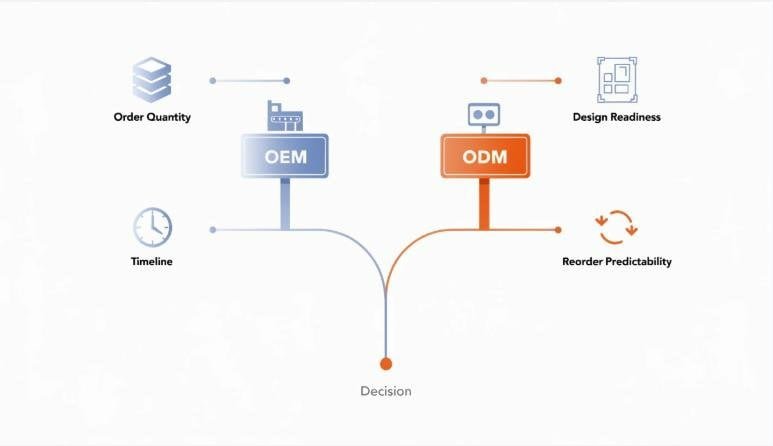
The Real Variables That Determine Your Path
Price per unit is the wrong starting point. I've seen buyers fixate on a $0.50 unit cost difference between OEM and ODM quotes, then blow their entire margin on unexpected sampling fees or rush shipping because they chose the wrong model for their timeline.
Here's what actually drives the decision:
| Decision Variable | OEM Requirement | ODM Requirement |
|---|---|---|
| Minimum Order Quantity | 1,000–3,000 units (varies by complexity) | 300–500 units (stock items may go lower) |
| Design Files Needed | Yes—CAD, technical drawings, material specs | No—select from catalog, provide logo artwork |
| Upfront Tooling Cost | $1,500–$8,000+ (mold fabrication) | $0 (using existing molds) |
| Sampling Timeline | 2–4 weeks (first round, excluding revisions) | 3–7 days (logo proofs, color matching) |
| Production Lead Time | 30–45 days post-approval | 20–30 days post-approval |
| Reorder Flexibility | Fixed to your mold—no sharing with competitors | Catalog item—other brands can order same base |
The MOQ trap catches buyers who see a competitor's "custom" bottle and assume they can order 500 units of something similar. If that competitor is on their fifth reorder, they've already paid mold costs. You're comparing your first-order economics to their mature-product economics.
Budget Allocation Math Buyers Miss
Let's work through actual numbers with a 1,000-unit order:
OEM scenario:
- Mold cost: $3,500
- Unit cost: $4.20
- Total: $7,700 ($7.70 per unit effective cost on first order)
ODM scenario:
- Mold cost: $0
- Unit cost: $4.50
- Total: $4,500 ($4.50 per unit)
On paper, ODM saves you $3,200. But if you reorder 1,000 units every quarter, your second OEM order drops to $4.20/unit because mold cost is already paid. By order three, you've recovered the mold investment and you're saving $0.30/unit ($300 per order) compared to ODM.
The decision isn't just first-order pricing. It's total cost across your expected order cycle. Buyers who know they'll reorder multiple times (subscription box companies, established retail accounts, corporate gift programs with annual budgets) should run the break-even analysis. Buyers testing an unproven market or running one-off campaigns shouldn't pay for OEM optionality they may never use.
The Design Readiness Filter
"Do you have design files ready?" is the question that separates viable OEM inquiries from premature ones. About 40% of buyers who ask for OEM quotes don't have:
- Technical drawings with dimensional tolerances
- Material specifications (304 vs 316 stainless steel, food-grade silicone durometer ratings, etc.)
- Component breakdowns (if the product has a lid, handle, or internal mechanism)
- Print-ready artwork for logos and surface graphics
If you're hiring a designer to create these files, add their fees and timeline to your OEM cost structure. If you don't know what "dimensional tolerances" means, you're not design-ready for OEM—and that's fine. ODM gives you a product selection where these decisions have already been made.
When the Answer Is "Start ODM, Transition OEM"
The path I recommend most often: place your first 500-unit order via ODM to validate market response. If the product moves, your second order can be 1,000 units ODM while you commission OEM tooling in parallel. Your third order ships from your custom mold.
This staged approach costs more than going straight to OEM (you pay higher ODM per-unit costs on orders one and two), but it removes the risk of funding a $7,700 OEM order for a product that doesn't sell. You're trading margin for validation.
Is Apple ODM or OEM?
This question comes up in about one in ten client conversations, usually after a buyer has Googled "OEM vs ODM examples" and found contradictory articles. The confusion is understandable—Apple's manufacturing model doesn't fit neatly into traditional OEM/ODM categories that make sense for drinkware buyers. But I'll address it because it clarifies how these terms work differently at scale.
Apple operates a hybrid model that's closer to OEM for design ownership and ODM for manufacturing execution. Apple designs products in-house (they create CAD files, material specs, assembly protocols), then contracts manufacturers like Foxconn to build to those specifications. Those manufacturers are technically OEMs because they're manufacturing to Apple's original design, but Apple doesn't own or operate the factories. For drinkware buyers, this distinction doesn't matter—you're choosing between bringing your own design files (OEM) or selecting from a manufacturer's catalog (ODM).
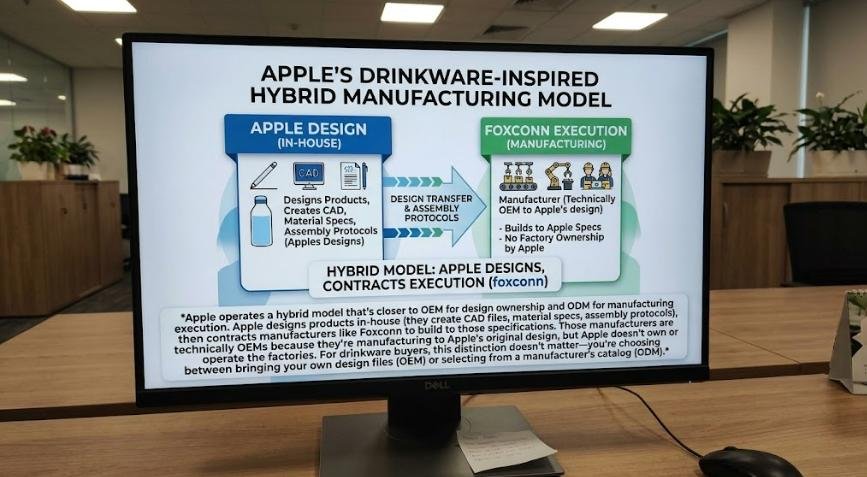
Why This Comparison Misleads Drinkware Buyers
I bring up the Apple example because it shows where the OEM/ODM framework breaks down at enterprise scale. Apple has the volume (millions of units) and capital (billions in supply chain investment) to dictate terms that small and mid-size drinkware buyers can't replicate.
When a buyer tells me "we want to do it like Apple," what they usually mean is: "We want full design control without owning manufacturing infrastructure." That's a reasonable goal, and it's exactly what OEM drinkware manufacturing provides—but the economics only work if your order volume justifies tooling costs.
The Apple model involves:
- Design ownership: Apple creates every specification, owns all intellectual property, and controls the entire product definition.
- Contract manufacturing: Apple doesn't operate the factories. Foxconn, Pegatron, and other manufacturers build to Apple's specs.
- Massive volume: Apple orders in quantities that let them amortize tooling costs across millions of units, making per-unit costs negligible.
For a drinkware buyer ordering 1,000–5,000 units, you get design ownership through OEM, but you're paying tooling costs that Apple's volume makes invisible. You don't get Apple's per-unit pricing leverage because you're not moving 50 million bottles.
What Drinkware Buyers Should Learn From This
The useful takeaway isn't "be like Apple." It's this: design ownership and manufacturing execution are separate decisions. You can own your design (via OEM) without owning a factory. You can scale production (via ODM) without designing products yourself.
The question for your business isn't "which model does Apple use?" It's "do I have the order volume to justify paying for design ownership upfront, or should I start with catalog products and invest in custom tooling after I've validated demand?"
Is ODM Cheaper Than OEM?
Three weeks ago, a client sent me an RFQ for 800 vacuum-insulated bottles. They wanted the lowest possible price and assumed ODM was the automatic answer. I sent back two quotes: one ODM at $4.80/unit ($3,840 total), one OEM at $4.40/unit plus $2,800 in tooling ($6,320 total). They went ODM to save the $2,480 difference. Six months later, they're placing order four and they've now paid $19,200 total for ODM bottles. If they'd chosen OEM, their total spend across four orders would be $16,720. They saved money in month one and lost money by month six.
ODM is cheaper on first orders because you're not paying mold fabrication costs—you save $1,500–$8,000 in upfront tooling fees. But ODM unit costs are typically 5–15% higher than OEM unit costs because you're paying for the manufacturer's design investment and sharing mold access with other buyers. Whether ODM is cheaper overall depends on your total order quantity across all purchases, not just your first order.
![ODM versus OEM cost comparison over multiple orders]
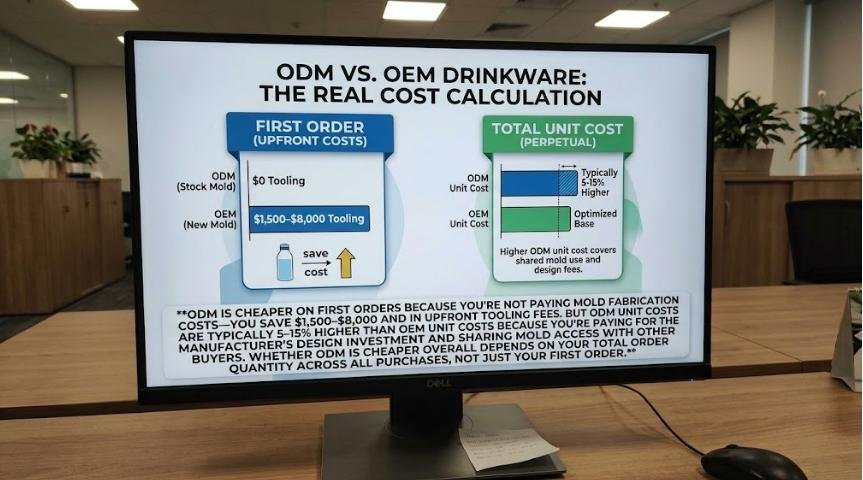
The Break-Even Math Most Buyers Ignore
Let's run the numbers with realistic drinkware pricing for a 16oz stainless steel bottle:
Scenario 1: Single 500-unit order (market test)
- OEM: ($2,500 mold) + (500 × $4.00) = $4,500 total ($9.00/unit effective)
- ODM: 500 × $4.30 = $2,150 total ($4.30/unit)
- Verdict: ODM saves $2,350
Scenario 2: Four 500-unit orders over 12 months (proven product)
- OEM: ($2,500 mold) + (2,000 × $4.00) = $10,500 total ($5.25/unit effective)
- ODM: 2,000 × $4.30 = $8,600 total ($4.30/unit)
- Verdict: ODM still saves $1,900
Scenario 3: Ten 500-unit orders over 24 months (mature SKU)
- OEM: ($2,500 mold) + (5,000 × $4.00) = $22,500 total ($4.50/unit effective)
- ODM: 5,000 × $4.30 = $21,500 total ($4.30/unit)
- Verdict: ODM still saves $1,000
Wait—why didn't OEM win in scenario three? Because in this example, the per-unit savings ($0.30) isn't large enough to